Paraset Power Output
|
|
 |
Many people make claims about the
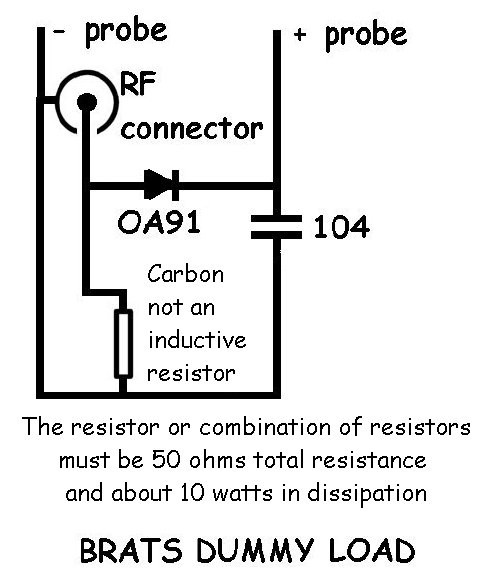
power output of their Paraset. Some of which we think are inflated. So if
you would like to know how much power your Paraset delivers then make this
dummy load....and send us your findings so we can build a small data-base
for others to look at. In time we will all get to know what to expect. You
may notice your Paraset might deliver more on the bench than when fitted
inside its' tin box. If you send in details let us know if your Paraset was
bench tested inside or out of its' tin box. Tell us if your Paraset is built
in a wooden box. This may affect results.
This diode senses the R.F. and rectifies it (this is what the diode is for) and the small capacitor smoothes the resultant D.C. giving an output voltage which can be related to power output. This dummy load is fairly accurate. Now whilst transmitting into the dummy load at full power as indicated by the aerial indicator bulb, measure the D.C. voltage across the probes on the dummy load. Now refer to the chart below and see what your output power is.
10.5v = 1 watt 14.6v = 2 watts 17.9v = 3 watts 20.5v = 4 watts 22.9v = 5 watts 25v = 6 watts 27v = 7 watts 28.8v = 8 watts 30.5v = 9 watts
|
| We would like to know what
output you get....but knowing this is not quite enough to be really meaningful.
So if you send in your output power results, tested as above.
For meaningful results we also need to know:-
What should you expect?.....look at the data-base and see for yourself.
|
|
For more details on results click this tab
|
|
|
|
|
|




